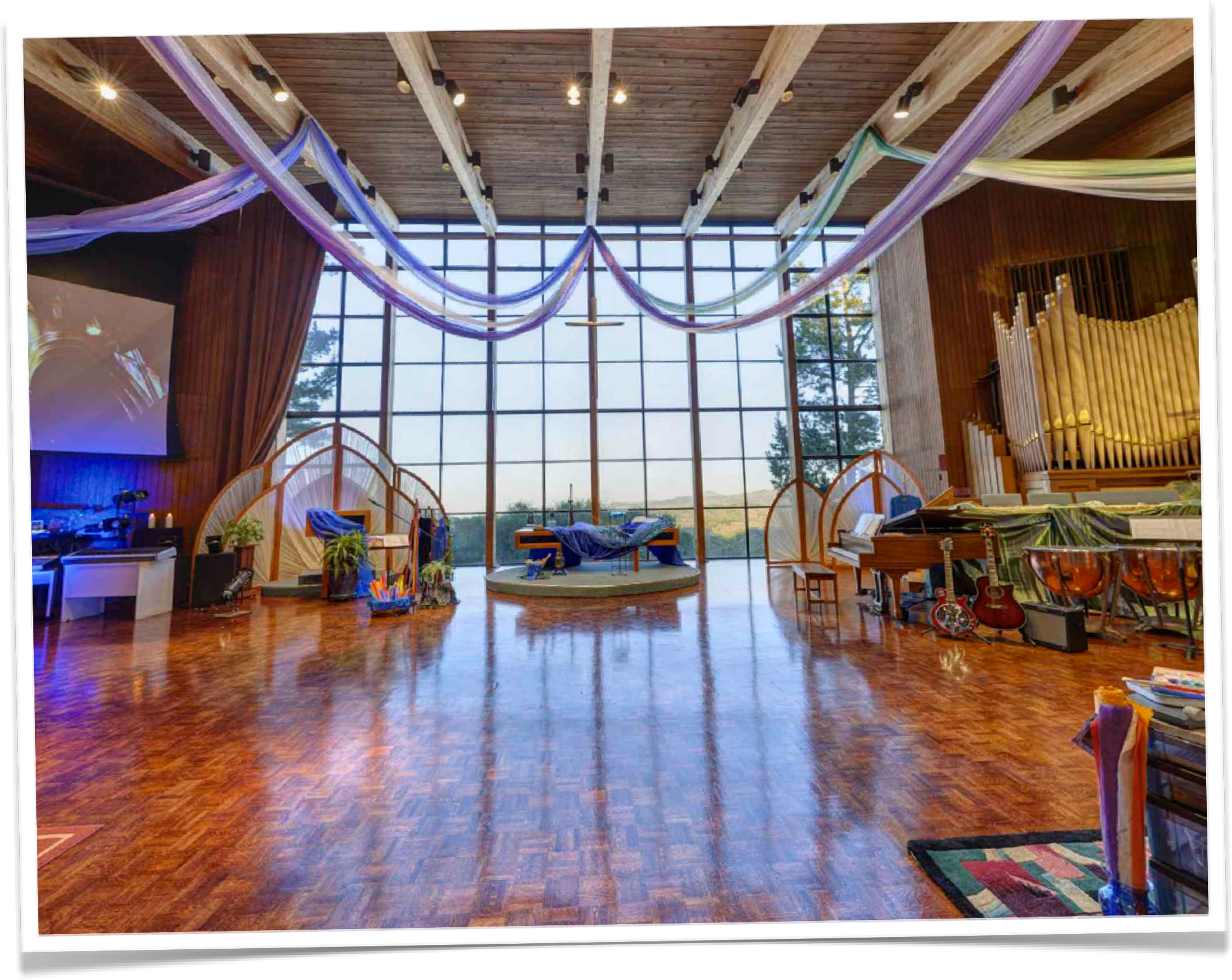

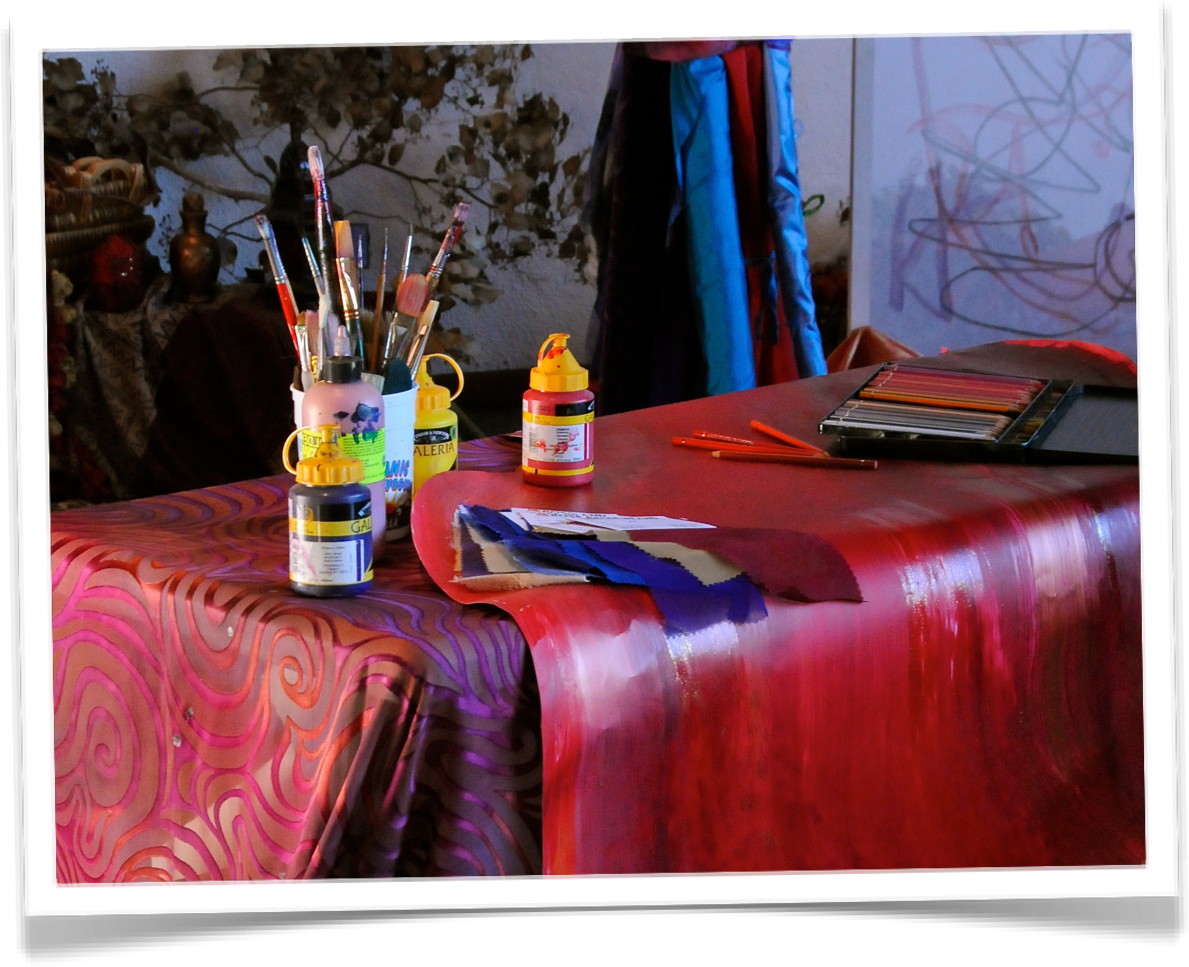
Greetings, visual artists! I want to address one of the most powerful, and the most ancient ritual art forms–the visual, symbolic arts. But, “Houston, we have a problem.” I call this problem our “theology of stuff” (or, actually, the lack thereof). Perhaps even more than our opinions about music, most congregations can get pretty bent out-of-shape when it comes to their quirks about the “stuff” of the sanctuary. We hold beliefs about what should or shouldn’t be on the table, what candlesticks (given “in memory of”) we must use forever-more, and why it would be absolute sacrilege to get rid of that modesty rail in the chancel that hides the choir members, who wear long robes anyway! I mean, how much modesty do we need?
Actually, it is no wonder we have problems over our worship stuff considering how attached we get to a lot of tangible items in our lives. And usually this attachment isn’t about the “stuff” at all.
Anger over changing the candlesticks isn’t about the candlesticks, it is usually about, for instance, the grief that most of the congregation no longer remembers “Aunt Betty,” stalwart saint of the church, whose name appears on the plaque. Losing the candlesticks means losing an era.
Our problem lies in that we’ve forgotten to associate the religious meaning and the spiritual depth that visual art forms offer. And when symbols lose their deeper meaning, we will attach any meaning to them. The candlesticks come to represent our attachment to Aunt Betty and a bygone era, not to the light of Christ that shines in our midst.
The “Ethos” of Worship
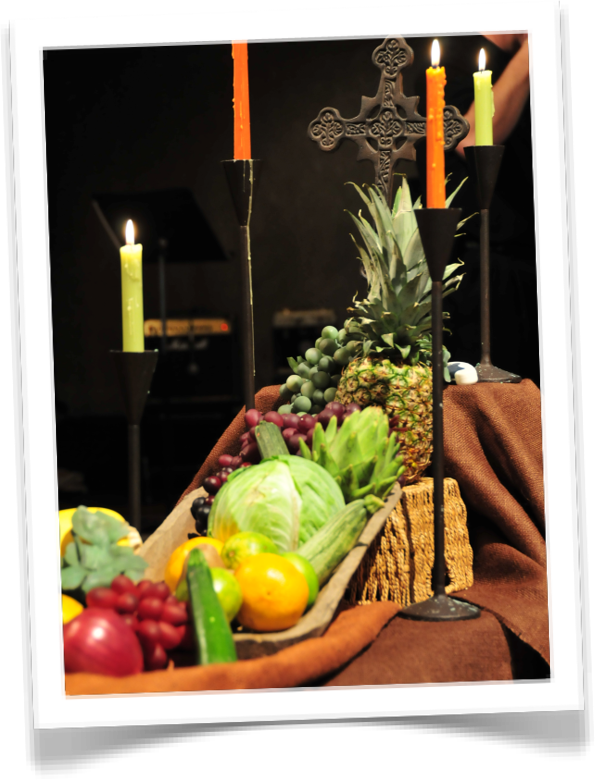
So a shift is in order. We’ve got to reclaim the bigger picture. Rather than a myopic focus on “stuff,” the visual arts can help us remember the main thing–how everything in our worship points us to, and immerses us in, the holy. In my teaching, “think like a filmmaker,” we see filmmakers utilizing the power of musical underscoring to create a mood. Likewise, colors and textures and lighting and objects are powerful symbolic tools for the art director of a film. As we continue to think like filmmakers in order to learn more about effectively telling the greatest Story, let’s shift our thinking to include the question of what “feel” we are creating for worship, or what “ethos.”
To talk of ethos is to understand the character, the feeling, the distinctive nature of the message that is being proclaimed. Is this season a time when the color scheme and lighting may be more meditative and colors subdued in deep blues or grays and the textures more rough or stark? Or are we in a message of abundance and hope that begs for an explosion of bright colors and light, effusive and not-so-contained cascading flowers? Are we singing a song that requires the graphics on the screen move from one to another with explosive energy or does the meditative nature of the singing offer an opportunity to use a transition that fades from one slide to another slowly, fitting the mood and energy of the moment?
In our mantra of “plan together and plan ahead,” the subject of the overall “feel” for a series is one that the whole team must have even before the resource-gathering stage of the creative process. This will make a difference for the kinds of resources you look for or create. Visual artists can really be the ones to help a worship team engage in this discussion because you know the importance of having a “palette” to work with.
Even if you are simply in charge of choosing fabric to swath the table, pulpit, font, etc., for the season, your choice will affect how people coming into the sanctuary will feel.
Color is emotion. Color can make a room feel cold or warm, cheery or dreary. And this will affect the way people experience the message.
Beyond Banners
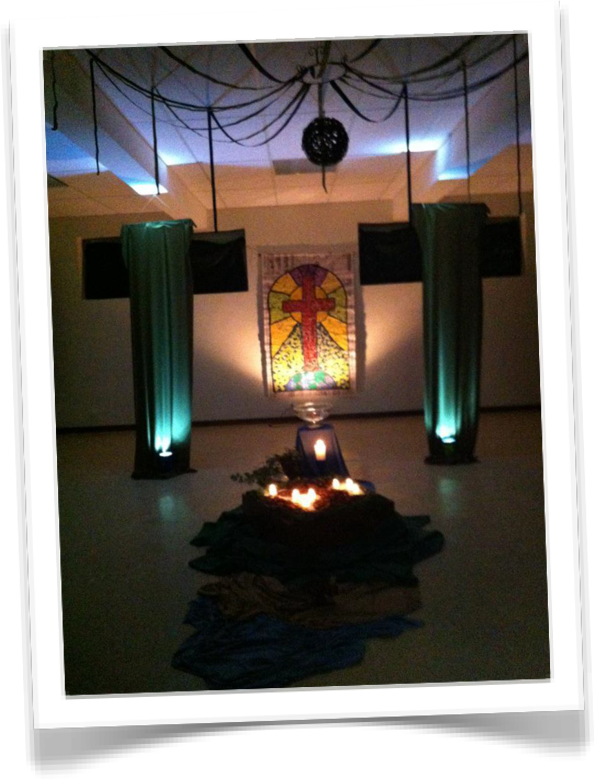
Once the ethos is established (and this may not be static, but rather a slow transformation that happens from the first Sunday of the series to the last), what are all the visual elements to consider that contribute to this overall picture? Here we come to another shift, one I like to call “beyond banners.” I don’t have anything against banners per se, but for too long our focus on how to enhance the sanctuary visually has stayed in the realm of two-dimensional art forms that are essentially over-sized bulletin covers on the walls (and that goes for how we’ve often used multimedia as well).
The visual aspects of worship extend beyond what we think of as “typical” liturgical art forms to include the whole environment of the worship space. Installing inexpensive dimmer switches for lighting, installing some black-out curtains if the space allows and incorporating simple LED flood lights shining up side walls can enhance your ability to make decisions about how much light and color a particular moment in worship requires in order to create a particular mood. Creating what I call “off-center worship centers”–smaller adaptations of the chancel worship center that appear in corners of or entrances to the sanctuary–can bring accents of the color scheme to the whole of the space.
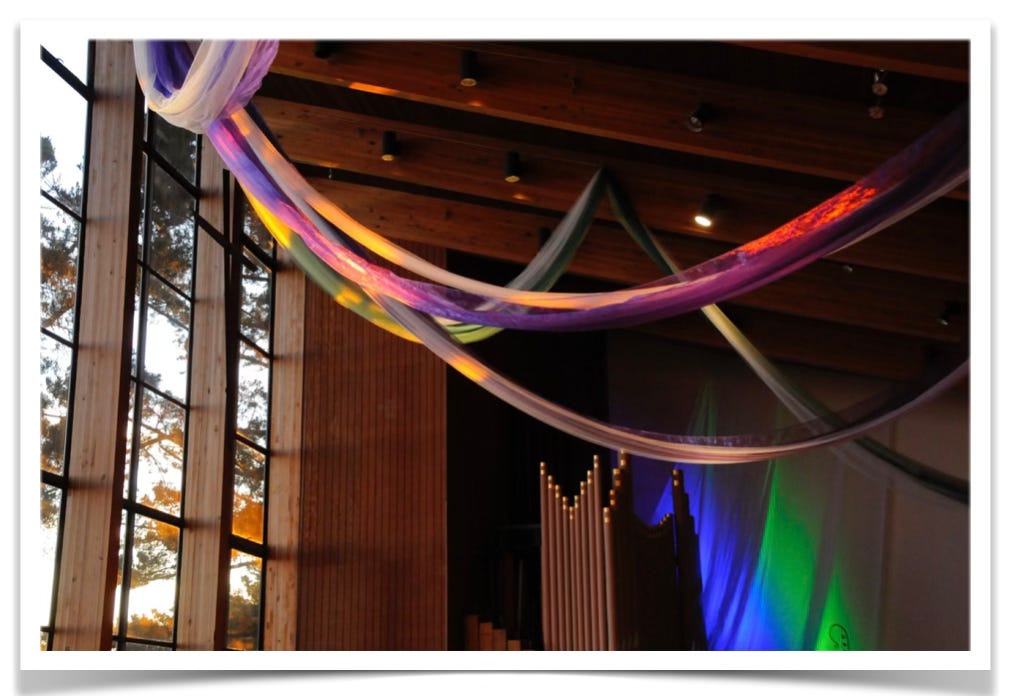
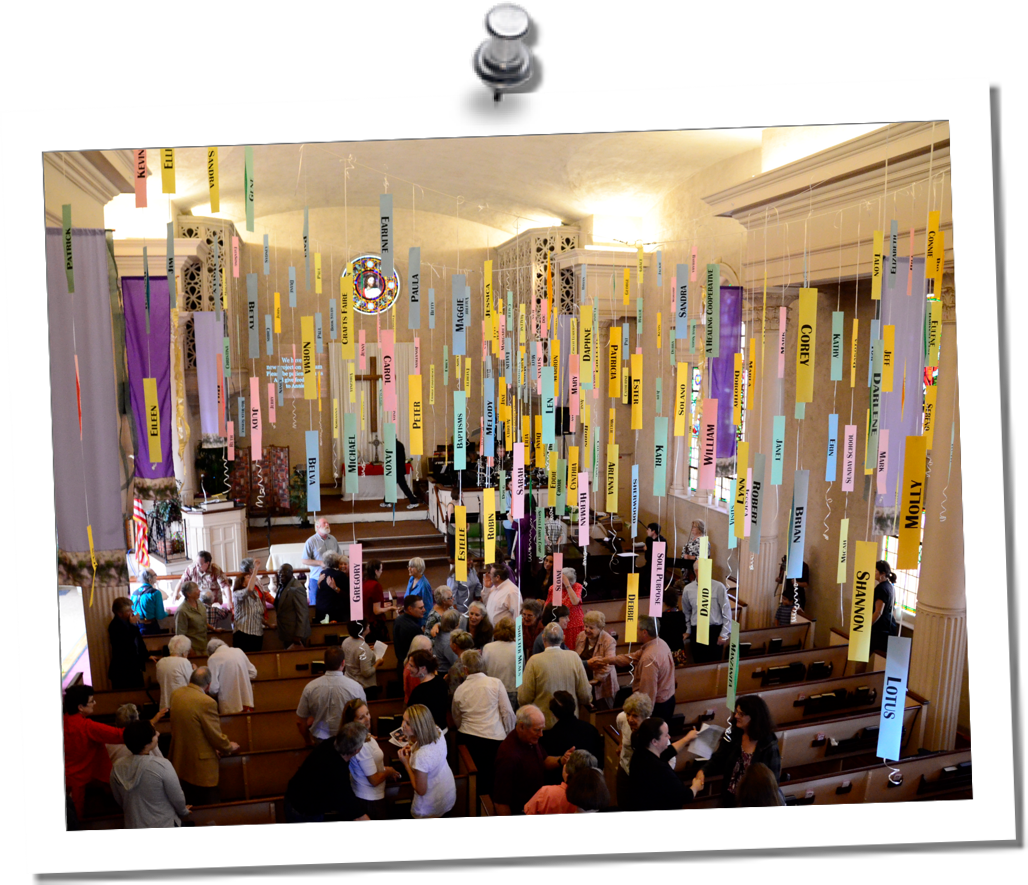
Installing a drop-line system (permanent pulleys in architectural arches or other structures made of simple eye-hooks and fishing line) can help you bring color and texture in fabrics hung and draped in the air space above the heads of the congregation.
Ribbons cascading from processional poles made of PVC topped with T-poles or round foam board disks can offer drama, literally “stirring” up the air with movement and energy to match a grand hymn or rhythmic global song.
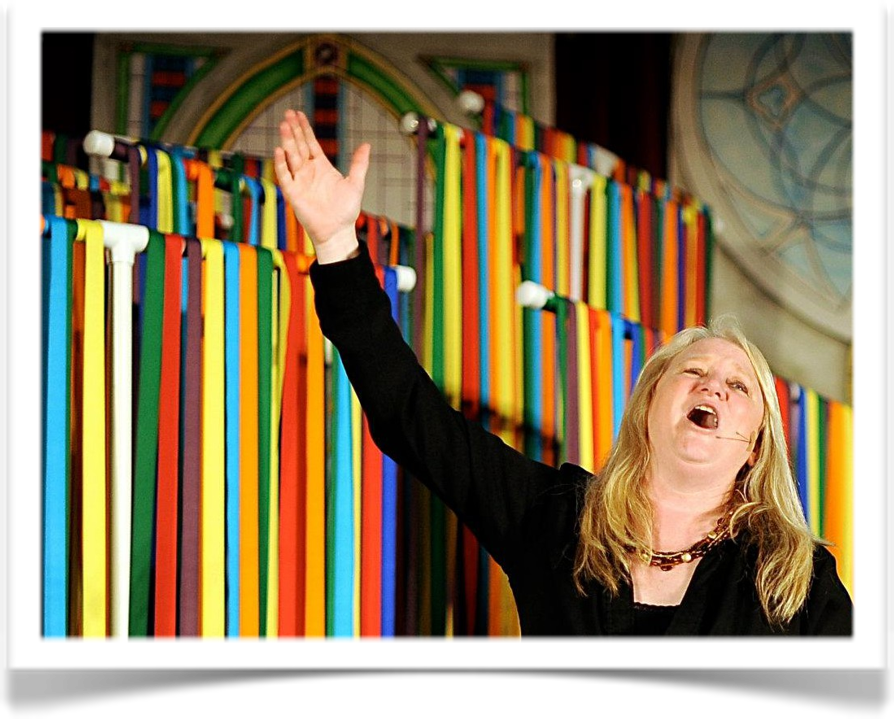
These are just some of the ways that the visual becomes much more than a two-dimensional representation of the message. When the visual “invades” the whole of the sanctuary space, we feel immersed in the action. The visual becomes visceral–it helps us become active worshipers and therefore active disciples.
Metaphoraging
While we are trying to look beyond just the typical “stuff” of worship, objects are an important part of what we must visually consider for worship. Symbolic objects have been a part of worship ever since humans began to ritualize meaning. We must consider the ancient and traditional symbols of our Christian story but we must also realize that all of our symbols originate in the ordinary stuff of life–water, bread, fruit of the vine, light–and that ordinary objects can be delightful carriers of spiritual meaning.
The Biblical writers themselves engaged in something we all do–“metaphoraging.” Metaphors are an important aspect of how we create meaning and foraging around in our ordinary lives for objects that can point us toward our faith story is one way we keep that story in front of us outside of worship, in our everyday lives.
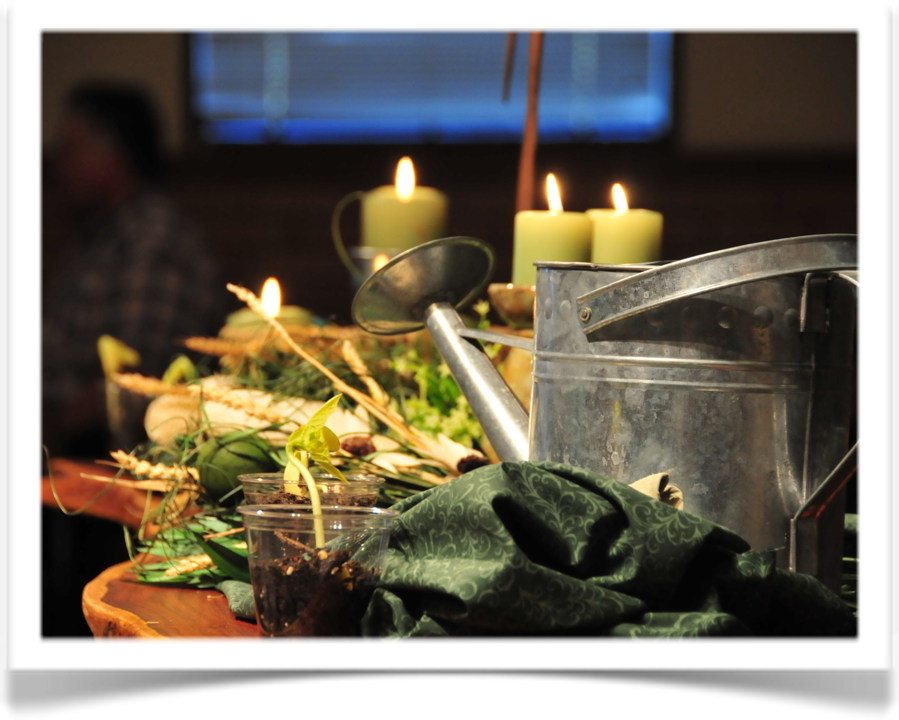
I love to utilize objects in worship that church members can literally bring from home. For instance, in a worship series about the steadfast promises of God, people were asked to bring rocks from home to be utilized on a worship center. The piling of rocks related to the altars of the Hebrew Bible built whenever holy encounters occurred and they also drew on the metaphor of God as “rock and redeemer” or modern-day phrases like “solid as a rock.” We sang “My God is a rock in a weary land” as people processed their rocks to the corner of the sanctuary where we would be reconfiguring those rocks in different arrangements each of the four weeks of the series. And then at the end of the series, each person took home a different rock than they brought (we added some for those that didn’t bring one), symbolizing the promises of presence we make to each other. Budget? $0.00! And now every time those folks see that rock in their yard, they are reminded of the extraordinary message of God’s ever-present love.
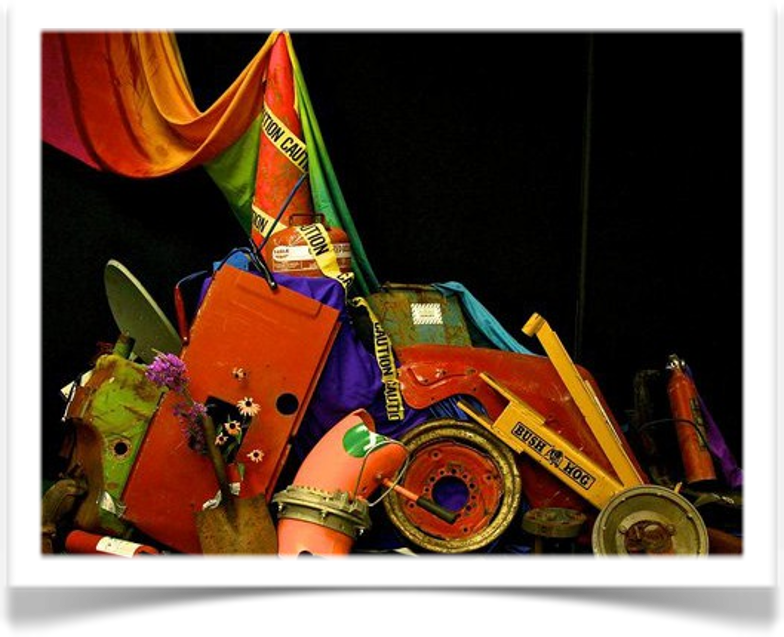
The possibilities are endless. I’ve pulled large items out of a junk pile in a back alley for a worship center about seeing life in the midst of death and placed more and more flowers springing from the junk for each service. I’ve done a worship series on Jeremiah and extracted the powerful imagery of God as potter for the main metaphor. We invited a potter to throw pots on a wheel at some point during each service as well as hold pottery classes at the church, then we sold the pots at the end of the series to make money for missions.
I’ve had people bring personal, ordinary glass pitchers they use in their kitchens filled with water from home to pour into a common vessel for a reaffirmation of baptism and month of focusing on “the water of life.” I’ve invited people to bring candles from home at the beginning of a worship series on the “burning passion” for mission and discipleship and had the youth group learn how to make candles out of chunks of all the wax from those candles so that each person could go home at the end of the series with a candle made from a common mixture. Are you also getting the point that having a small visual arts budget can sometimes offer more, not less, opportunities for incorporating the visual arts?
Moving Images
Lastly, I want to encourage you, no matter the size of your church or budget or your style of worship, to consider exploring the exciting possibilities that projection technology brings. (Note: there is another Foundational Article about Media Arts in that Artist Area but I wanted to include this here since churches who don’t have projection might not visit the Media Artist Area). We’ve come a long way from simply projecting lyrics, clip art and movie clips on a screen. Projections on a light-colored wall surface or artfully-hung piece of stretch lycra in a front corner (which can free up congregations from the angst of figuring out where to hang the not-so-aesthetically-pleasing and expensive screens) can offer sensory-rich storytelling avenues that incorporate both local and global photographic imagery, classical, traditional and contemporary art, specially-produced videos for liturgy and scripture, as well as facilitating the participation of the people with texts accompanied by images for singing or speaking (note: the latter is not a replacement for worship guides or printed music when congregational participation would be enhanced by these forms).
For a very reasonable amount of money, this is one of the most exciting visual artistic endeavors I get to do, whether it is for one of the big conferences I design or for my local chapel worship. I spent $1,500 for a very good portable LCD projector with enough brightness and clarity for almost any church worship space I encounter.
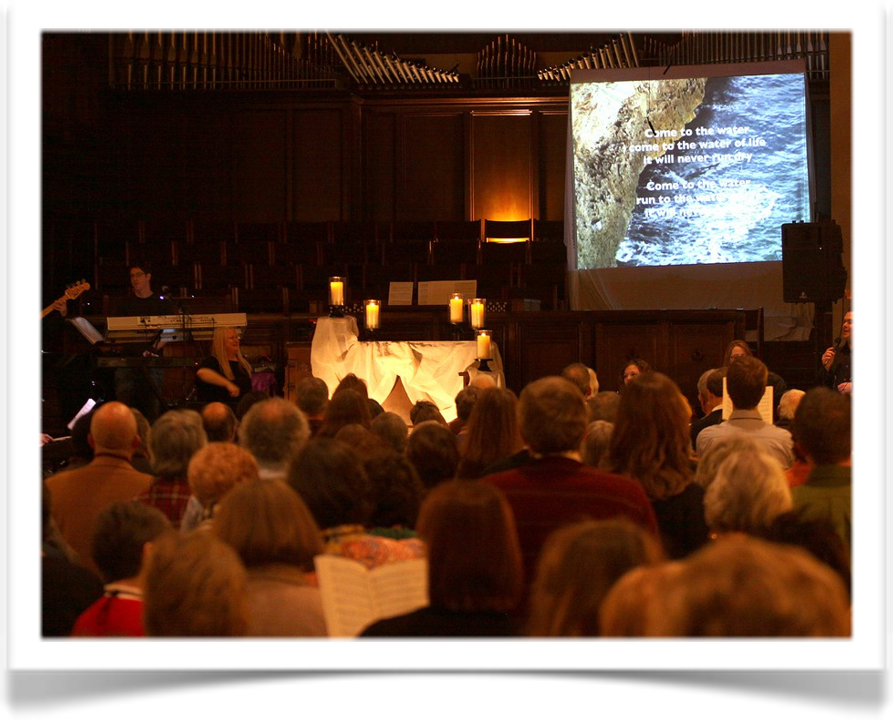
I spent $200 on a piece of white stretch lycra that is big enough to adapt to any space or shape I need it to fit. I have a very average-priced digital camera for stills and video that I regularly give to someone and say, “get me some pictures of [whatever]” that I can easily download instantly into my presentation. I take close-up pictures of worship centers I create so that the same colors and images and objects show up on the screens as well. And I use my $79 software program (Keynote for Mac) that enables me to create seamless and varied transitions, builds in and out, words on top of video loops, embedded music, and much more. So much is now possible to enhance the visual and media aspects of our worship, so very important in a world in which all communication has become more visually communicated!
Ingenuity and Integrity
The impact of incorporating any visual art into worship is significant.
But one of the biggest mistakes is to cram it with a bunch of stuff just because it looks cool or just because you can.
The root meaning of the word “integrity” is that all the pieces work together for the whole. Choices for how you create a visual environment must begin with how it will enhance, support, and at times carry the message. Choices about what to include must also be coupled with choices about how and when to include these elements and when not to include them. Worship can become “busy.” This is true in relationship to words and to music, and this same principle applies to the visual. A series of services ought to have a unified palette that may change or morph slightly over the series but also offers visual continuity that enhances our memory of the message.
More is not always better. You may find an amazing object to use, but it may not be the size and scale needed for the space. Sometimes we can be too literal and images become a regurgitation of what text provides.
Because the visual arts are collaborators with other art forms, they can afford to be more abstract, letting colors, textures and photographic images be symbolic and evocative rather than prescriptive.
Bottom line: as with all the languages of worship, visual artists are ritual artists. We don’t create for the gallery or for home decoration and design. We create in order to tell a faith story, evoke and inspire discipleship and change lives. What better artful purpose is there?
- Dr. Marcia McFee
Discussion Questions
Were there ideas in this article that we could explore further?
Do we start our design process with a discussion about what the color/mood “palette” of the series will be?
What limitations are we dealing with in our worship space and how could we creatively overcome those?
Thanks for being part of the Worship Design Studio!